








About the project:
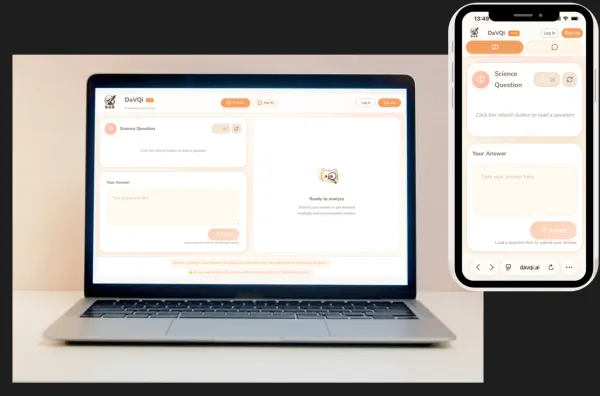
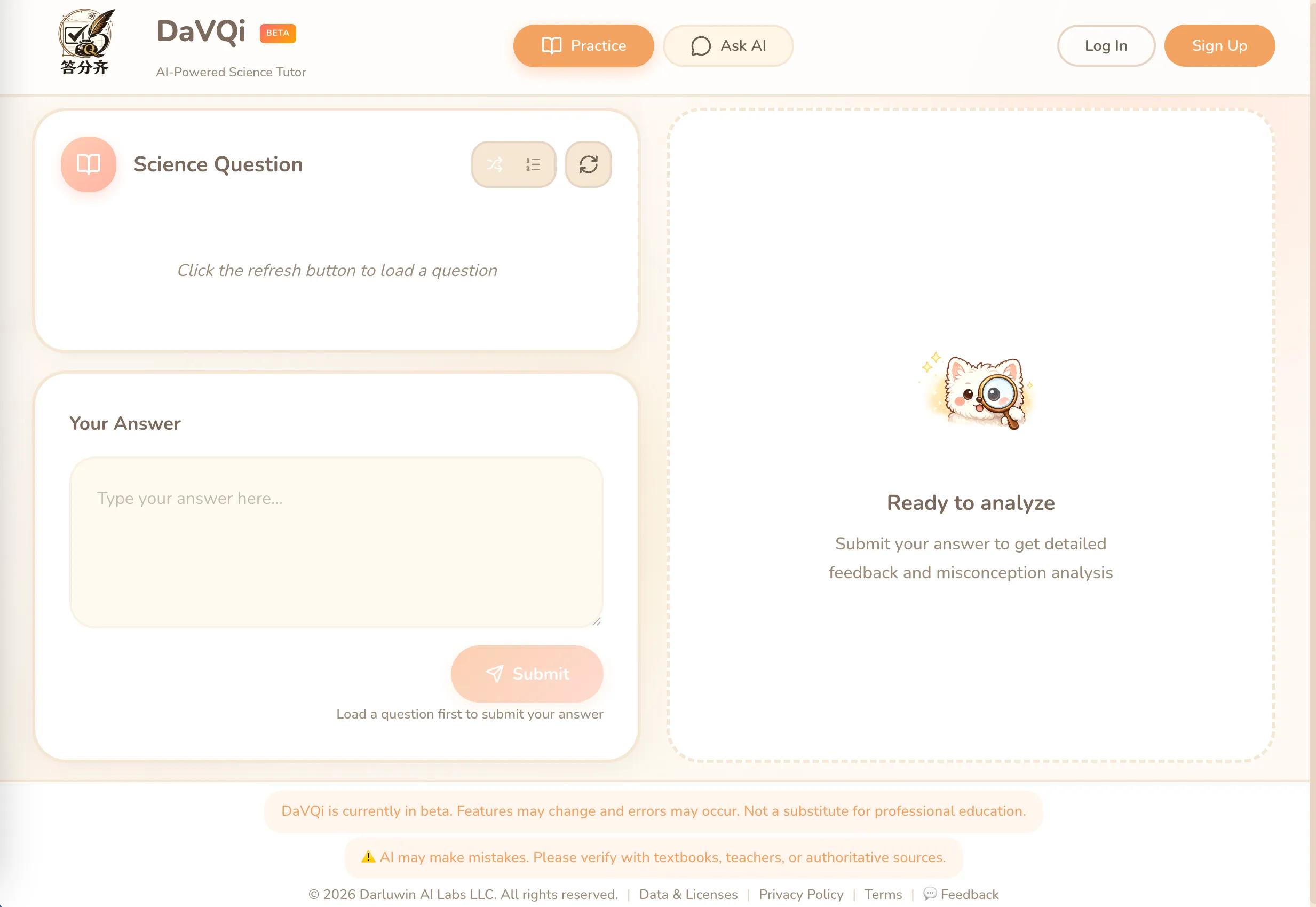
An AI-powered science practice companion for K–12 and homeschool learners. Students get targeted practice questions across key topics and receive instant, rubric-style feedback on short answers—not just right or wrong, but why. The system analyzes responses to identify misconceptions, highlights missing concepts, and provides actionable hints and explanations tailored to the student’s level. Parents and educators can track progress over time with clear summaries of strengths, weak areas, and recommended next practice. Designed for quick daily practice, review before tests, and guided homeschooling sessions—making science learning more efficient, engaging, and confidence-building.
Features
>Students receive rubric-style feedback on short answers instantly—not just right or wrong, but detailed explanations of why.
AI analyzes responses to identify common misconceptions (e.g., confusing mass vs. weight) and provides targeted corrections.
Questions and hints are tailored to the student's level, making learning more personalized and effective.
Parents and educators can track progress with clear summaries of strengths, weak areas, and recommended next steps.
Comprehensive practice questions across key science topics for elementary through high school students.
Designed for quick daily practice, test review, and guided homeschooling sessions.
Features
>What I Built
>- ▹ Led end-to-end product development from concept to launch
- ▹ Built NLP pipeline for short-answer grading and misconception detection
- ▹ Designed and implemented the feedback rubric system
- ▹ Developed React frontend with responsive UI/UX
- ▹ Created Flask backend APIs for real-time inference
- ▹ Deployed and maintained production environment on Vercel
What I Built
>Tech Stack
/> Python
Python is a high-level, versatile programming language known for its simplicity and readability, widely used in data science, AI, web development, and beyond.
 Scikit-learn
Scikit-learn is a popular open-source Python library that provides simple and efficient tools for machine learning, including classification, regression, clustering, and model evaluation.
 HuggingFace
HuggingFace Transformers acts as the model-definition framework for state-of-the-art machine learning models in text, computer vision, audio, video, and multimodal model, for both inference and training.
 Spacy
SpacyspaCy is an open-source library for advanced Natural Language Processing (NLP) in Python.
 React
ReactJavaScript library for building user interfaces with reusable components.
 Flask
FlaskFlask is a lightweight WSGI web application framework. It is designed to make getting started quick and easy, with the ability to scale up to complex applications.
 HTML
HTMLHyperText Markup Language for creating the structure of web pages.
 CSS
CSSCascading Style Sheets for styling the presentation of HTML documents.
 Vercel
Vercel is a cloud platform that provides the tools and infrastructure for developers to build, deploy, and scale modern web applications, focusing on speed, developer experience, and global distribution.
 Google Colab
Google Colab is a free cloud-based platform that lets you write and run Python code in Jupyter notebooks, with built-in support for machine learning libraries and free GPU/TPU access.
 SHAP
SHAPSHAP (SHapley Additive exPlanations) is a game theoretic approach to explain the output of any machine learning model. It connects optimal credit allocation with local explanations using the classic Shapley values from game theory and their related extensions.
 Figma
FigmaFigma is a cloud-based design and prototyping tool for creating user interfaces for digital products like websites and apps, emphasizing real-time collaboration for teams. Key features include design, prototyping, and design system management.